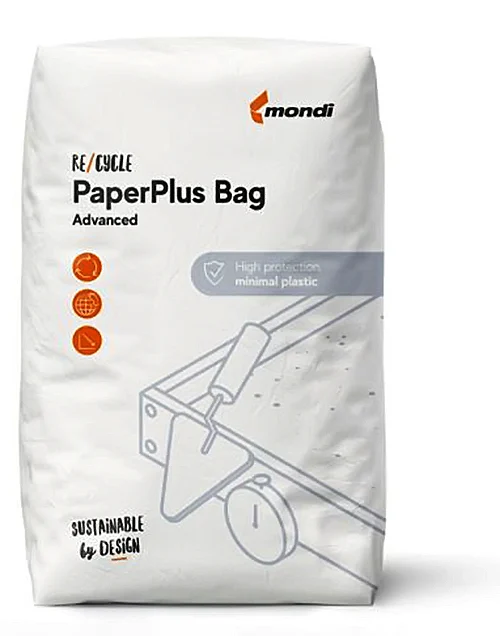
Mondi, the world leader in the field of environmental packaging and paper, releases its highly effective paper bag of Paperplus Bag Advanced, designed to protect the humidity sensitive to humidity, while significantly reducing the content of polymers.
An innovative solution designed to protect powdered products offers excellent moisture protection and supports processing.
Paperplus Bag Advanced is a paper sac with a highly effective barrier film that reduces the use of polymers in the construction industry. The bag has a thin highly efficient film of 20 μm to ensure moisture protection sensitive to humidity products. Compared to 50 μm film bags, it has 60% less polymers and a lower carbon footprint, according to your own Mondi PIA (Product Impactment Assessment) based on the life cycle, offering a comparable level of product protection. As part of the portfolio Mondi Recycle, Paperplus Bag Advanced was tested and confirmed its suitability for processing according to the Cepi test and 4evergreen testing protocol.
“Paperplus Bag Advanced is a ready -to -future alternative for customers who seek to reduce the number of polymers and meet the requirements for performance without harming efficiency. Mondi is ready to support its customers, taking into account the impact of its products on the environment at each stage Circular economy, fully adapting to customer needs, “Max Melzer stressed, head of the external sales department of industrial bags Mondi
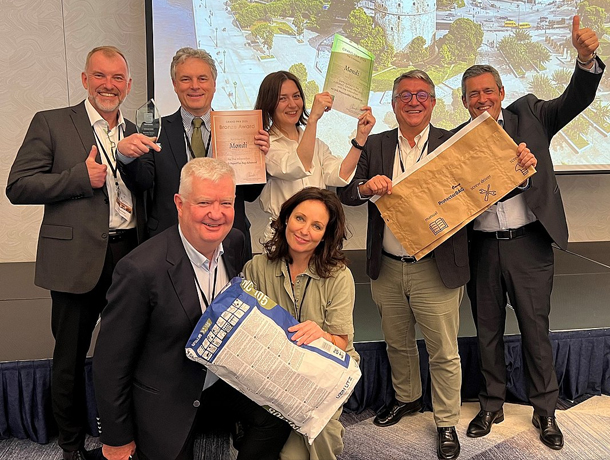
After another year, the highest level of the first round of the judiciary has ended, and now the international expert jury of the world’s most prestigious ecological packaging competition announces Sustainability Awards 2025!
It was a variety of international finalists for today, with more applications from outside Europe and North America than ever. We are pleased to welcome so many world -wide innovators in Ethiopia, India, China, Brazil, Australia and other countries.
This year’s cohort covers a wide range of topics: from a number of fiber and biological materials to the technologies of correction and decomposition; from canning packaging and intellectual sensors to logging efforts; From protective designs for e -commerce to sources of “green” hydrogen.
As always, we are amazed by such high ambitious plans and creative ideas of each nominee. It was difficult to reduce the number of finalists to fifty one; It will be even harder to choose only eleven winners who will receive the desired crystal trophy.
We will announce the winners of the Sustainability Awards 2025 at this year’s even more and even better summit of sustainable packaging, which will take place in Utrecht (Netherlands), from November 10 to November 12.
So, this year’s Nobel Prize for Innovation in Sustainable Packaging – Sustainability Awards.
Best Practice:
Coveris – Recover paper processing plant;
Sonoco – smart, processing food banks for Fareshare charitable donations;
Trayak – EcoimPact Sustainability Intelligence Platform for data analysis;
ICIS – ICIS prices index.
Climate:
DS Smith and Krones – an alternative to fibers and Litepac Top for bottling cartoons;
Sonoco – Ecopeel three -component bank;
ARDAGH GLASS PACKAGING – a hydrogen electrolyzer for glass melting;
Ambipar – Sustainable BioCapsules Project Project for reuse of pharmaceutical packaging waste for forest recovery;
FlexPenser – FlexPenser one -sided valve/pump.
Circular economy drivers:
Glacier and 100+ Accelerator – artificial intelligence Glacier Recycling for automated recovery and real -time data;
DHL Express – multiple pallet wrappers;
Procter & Gamble – recycling technology based on Versovita solvents;
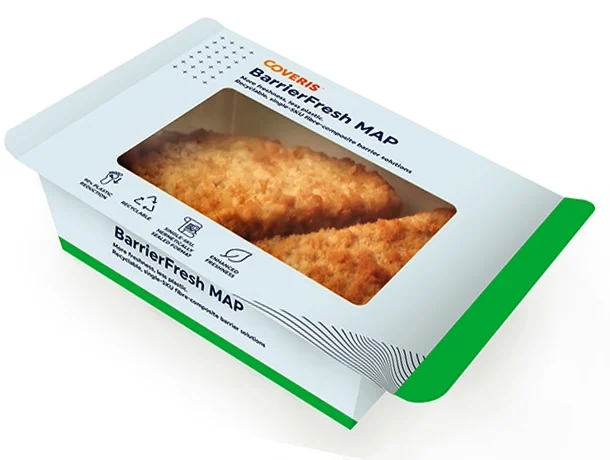
Coveris has introduced a new solution – cardboard trays made of MAP for meat, fish and poultry.
It is noted that in the new Barrierfresh Map trays, the number of polymers is reduced by 90%, while their processing and the shelf life of the product are maintained. They combine cardboard and a specially designed Evoh barrier film to create a fully printed, hermetically packed single pack.
Coveris explained that a 21 day package is “ideal” for breaded poultry, meat and fish, as well as ready -made food. Barrierfresh Map trays are described as lightweight, stacked and compatible with many available machines, according to use.
Will Mercer (Will Mercer), Director of the COVERIS Business Division and Development, said: “Our Barrierfresh Map tray marks a unique breakthrough in this category, offering a solution with a reduced polymer content and a reduced amount of packaging, which provides the same. Opportunity for consumer. The launch of Barrierfresh Map trays is perfectly consistent with our vision of No Waste and maintains an increase in industry demand for alternatives with reduced polymer content. “
The global packaging market has been growing continuously for over 10 years with constant dynamics. At the same time, in the segment of folding cardboard boxes in the long run, especially in the sectors of food, drinks and consumer goods, growth rates exceed the average. This market segment is mainly served by large -scale sheets of large format of class 6 (105×145 cm).
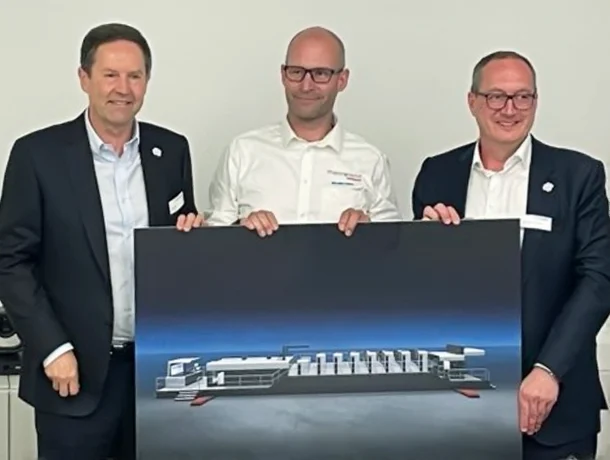
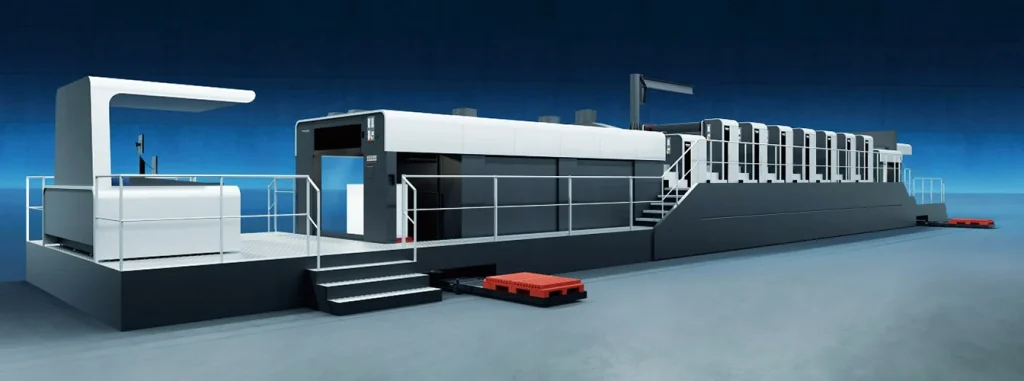
Just to its 175th anniversary, Heidelberger Druckmaschinen AG expands its portfolio at the expense of Cartonmaster CX 145. This new printing machine is focused on clients with large volumes of packaging and complements the available assortment of printing machines for folding cardboard boxes.
From Cartonmaster CX 145, Heidelberg positions itself as a supplier of complex solutions for industrial production of folding cardboard products. Within the company growth strategy, this closes a strategic gap in the product range.
“With our new Cartonmaster CX 145, Heidelberg is a full spectrum provider for printing compiled cardboard boxes,” says David SchMedding, David SchMedding, David SchMedding). “As part of our growth strategy, we expand the range of products in the packaging sector and at the same time close the gap in our portfolio.”
Digital Integration and Global Expertise in Services Cartonmaster CX 145 is based on Roland Evolution 900 from Manroland Sheetfed and fully integrated into the Heidelberg digital ecosystem. The machine can be integrated into the PRINECT workflow as well as into foreign developers. Productivity data is available at any time on the Heidelberg client portal.
In addition to installing the Heidelberg machine, the service also includes the sale, installation, training of users, technical support and supply of supplies.
Producers of large circulation packaging attach special importance to the availability of machines, low complexity and efficient, accessible worldwide service. Heidelberg resolves the issue with the help of global service infrastructure, which provides short response and supply of spare parts at the local level.
Cartonmaster CX 145 is already on sale. The first installation for customers is scheduled for 2026 and then global deployment. The highest demand is expected in North America, Europe and China.
System Supplier for full production of folding boxes By presenting the Cartonmaster CX 145, Heidelberg emphasizes its claims for the title of system supplier for cross -cutting cardboard boxes. The existing portfolio includes a series of Speedmaster machines in 50×70 cm and 70×100 cm formats, as well as a high -performance machine of Speedmaster XL 106.
For post -printing processing, Heidelberg collaborates with its partner MK Masterwork and offers integrated solutions using automation and robotics. In the field of high -performance production of folding cardboard boxes Boardmaster based on rolls is the pinnacle of assortment.
The new Cartonmaster CX 145 shortens the gap between Speedmaster and Boardmaster. All machines are part of the Heidelberg digital ecosystem, which consists of hardware and software, supplies, service, training and consulting. The goal is to gradually expand this proposal to a comprehensive solution for packaging clients.
“With the addition of the Cartonmaster CX 145 to our portfolio, we emphasize our approach as a system integrator for through production of folding cardboard boxes,” says Jürgen Otto, CEO Heidelberg. “Thanks to our very good position in the segment of folding cardboard, we expect a high level of demand and an increase in sales of a new range of products.”
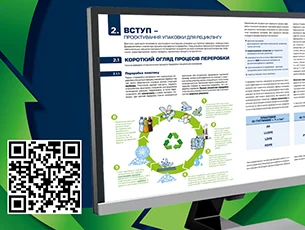
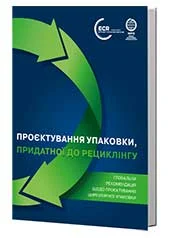
At the initiative of WPO, the University of Applied Sciences in Vienna, together with its partners, developed global guidelines for designing circular packaging – “Design for Recycling: Guidelines for Packaging.” Each of the 53 member countries of the World Packaging Organization received exclusive rights to translate and publish the guidelines in their national language.
The Packaging Club of Ukraine took advantage of this opportunity and translated the document into Ukrainian. These guidelines serve as a valuable reference, helping packaging manufacturers consider recyclability already at the design stage — enabling easier recycling, higher-quality secondary raw materials, and reduced environmental impact.
The guidelines cover:
General information on sustainable development, circular economy, and recycling processes;
Design recommendations based on three key criteria:
Materials and additives
Decoration and other components (labels, coding, inks)
Closing systems (caps, seals, foils, opening aids)
A traffic light system is used:
Green – optimal material combinations
Yellow – acceptable if necessary
Red – should be avoided, as such packaging is nearly impossible to recycle and ends up incinerated or landfilled.
The guide also details packaging types: bottles, trays, cups, flexible packaging, tubes, cans, crates, composite packaging, buckets, canisters, wooden containers, and more.
It is interactive and user-friendly:
Click bold blue underlined terms to access glossary definitions
Click contents to jump directly to sections.
📥 Download for free from: https://cutt.ly/fw7yZG2Z Available on the websites of the Information and Analytical Center (section “Bookshelf”) and the World Packaging Organization (WPO) (section “Resources”).
Preparing for K’2025 in Dusseldorf, Clariant has announced the launch of the Addworks PPA product line – a new generation of polymer polyolefin -designed polyolefin extrusion. This innovative solution corresponds to the growth of the industry’s need for more eco -friendly alternatives to traditional additives based on fluoropolymers, while maintaining high productivity standards.
The new line includes Addworks PPA 101 FG, focused primarily on the markets of Europe, the Middle East, Africa, America, Southeast Asia and the Pacific region, and Addworks PPA 122 G, oriented to the Great Regions, Southeast Asia. Both products are available on sale and offer manufacturers a timely solution as regulatory restrictions on PFAS continue to intensify around the world.
“Our new Addworks PPA product line is a significant breakthrough in the environmental processing of polymers,” said Diederik Goyvarts Diederik, Global Business Development Manager for Polymeric Solutions in Clariant. – By developing alternatives without perfluo oils (PFAS), which correspond to or exceed the characteristics of traditional additives, we help our clients outstrip changes in regulations, while maintaining high quality standards that their end consumers expect. “
Innovative formulas do not contain per- and polyfurrels (PFAS), as well as inorganic, silicone or polysiloxane materials. This composition meets many regulatory requirements, including food in contact with food and packaging, covering a critical need for the packaging industry. In addition, decisions without PFAS meet the processing requirements in accordance with the EU Regulations on packaging and packaging waste (PPWR), which is even more in line with the goals of the industry for sustainable development.
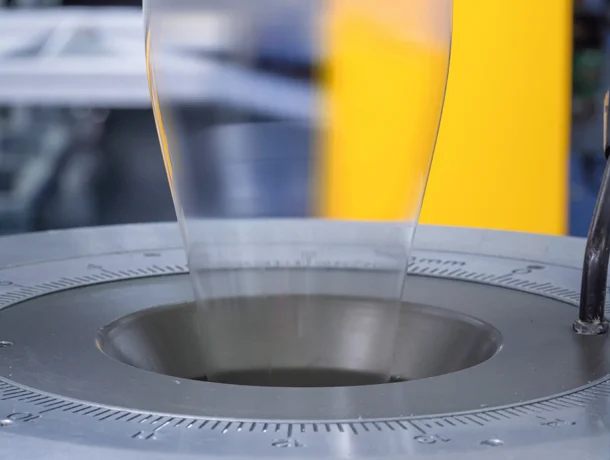
Manufacturers who use new Addworks PPA solutions can expect a significant improvement in processing, including increased extrusion efficiency, effective elimination of “shark skin” defects and excellent smoothness of the film surface. Products also retain neutrality on optical and mechanical properties without negative impact on the level of strength, tightness or friction coefficient – critical factors for further operations.
Addworks PPA 101 FG has 100% active fine -grained composition, which can be easily injected with the main resin, uterine mixture or concentrate. Meanwhile, Addworks PPA 122 G is supplied in a convenient form of uterine mixture for easy use, which requires the same dosage level as traditional uterine mixtures of polymer technological additives, which simplifies the transition for manufacturers.
The versatility of these new technological additives makes them ideal for a wide range of applications, including extrusion of plastic wrap with blowing and casting, which are commonly used in the packaging, agricultural and construction industry. Film users especially benefit from improved surface quality and processing efficiency that provide these additives.
The introduction of the Clariant line by Addworks PPA reinforces its desire to develop more sustainable solutions that meet both regulatory problems and performance requirements. Since global rules are increasingly aimed at PFAS through environmental and medical problems, the proactive approach of the Clariant provides clients with future -oriented decisions that support operating excellence while promoting sustainable development goals. This emphasizes Clariant’s desire to develop solutions that correspond to the growth of consumer priorities and brands on health, transparency and sustainable development. As the demand for well -being and minimizing environmental impact is increasing, Clariant offers innovative ingredients and materials that help brands meet the changing market expectations and regulatory requirements.